Setting the Record Straight
© Sylvain Riouall
Marathon Runner · Republican Guard · French National Team
On August 3, 2024, the Athletics Integrity Unit (AIU) confirmed a two-year suspension for Mehdi Frère. This page explains the facts — clearly and without omission.
Who is Mehdi Frère?
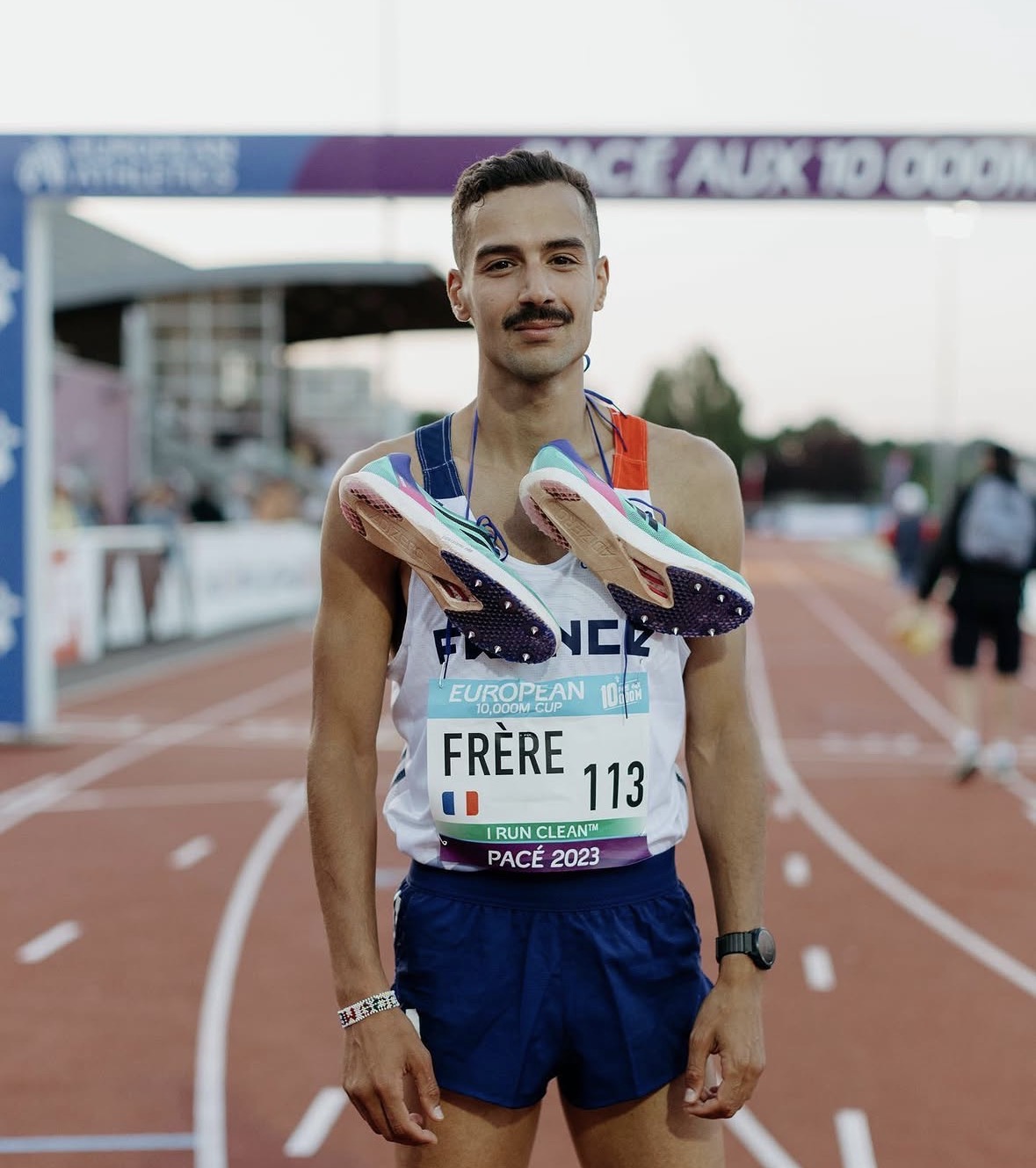
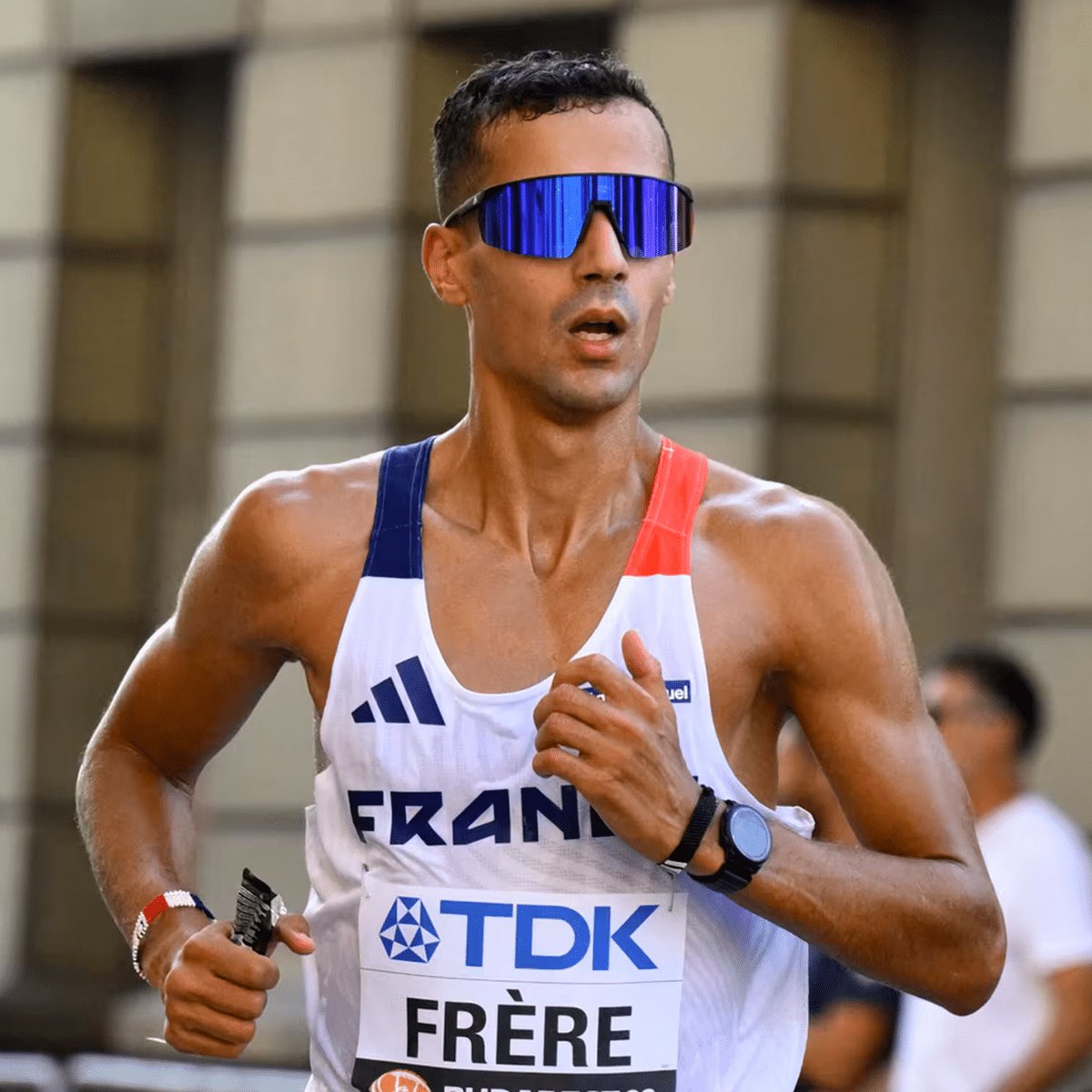
Mehdi Frère was born on July 27, 1996. A member of the Republican Guard — an elite branch of the French military — he has built a high-performance athletics career alongside his duties as a soldier. Specialising in the marathon and road running, he established himself as one of the finest long-distance runners of his generation in France, earning 8 senior international selections and 6 youth international selections for the French national team.
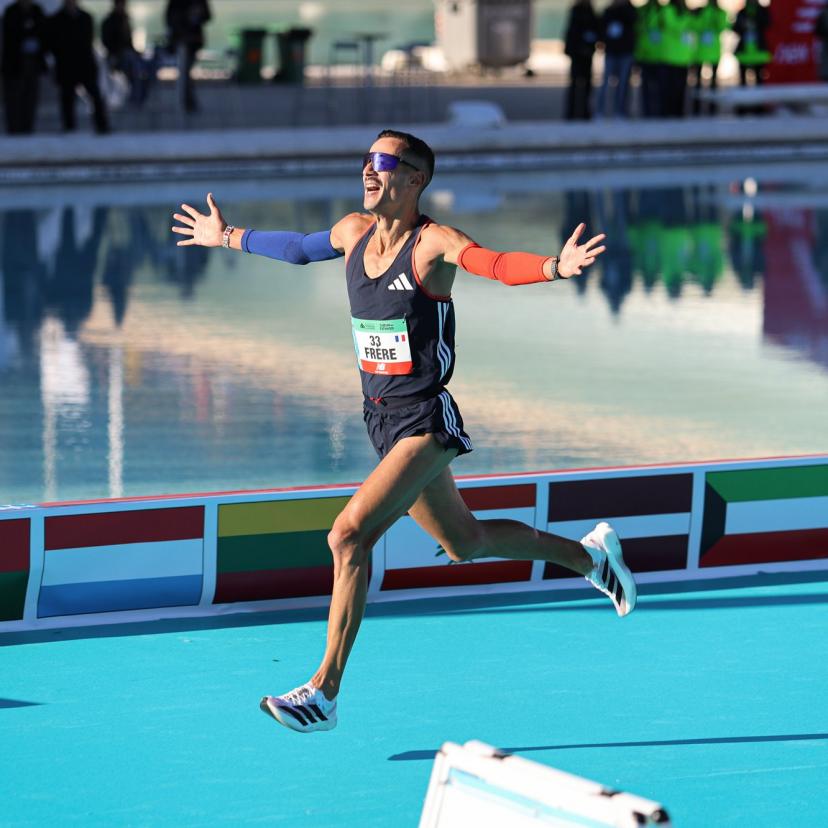
His story is one of relentless dedication: training volumes reaching 150 to 200 kilometres per week, while fulfilling the demands of military life. At the end of 2023, in Valencia, he reached the peak of his career — setting the second-fastest marathon time ever recorded by a French athlete, finishing 1st European and 9th overall, and securing his place on the Olympic team for Paris 2024.
© Jean-Marie Hervio
© Stadion
Career highlights
Anti-doping context
At the elite level, certain athletes are placed in what is known as a Registered Testing Pool (RTP). In practice, this means they can be subjected to anti-doping tests at any time — at home, in training, while travelling — without any prior warning.
To make these unannounced tests possible, each athlete must update an official app called ADAMS every single day, declaring a one-hour time window during which they are reachable and their exact location. If that information is inaccurate, or updated too late for a test to be organised, it counts as a whereabouts failure. Three failures within any twelve-month period automatically trigger a two-year suspension — regardless of intent or circumstances.
Mehdi Frère is placed in the testing pool of the French Anti-Doping Agency (AFLD) in 2021, owing to his level of performance. From that point on, he is required to submit his whereabouts daily in ADAMS.
Following his exceptional performances in late 2023 and his Olympic qualification, Mehdi Frère is also added to the international testing pool of the Athletics Integrity Unit (AIU). He is now subject to two overlapping surveillance systems simultaneously.
Following three whereabouts failures, the AIU issues a provisional suspension on June 4, 2024 — ruling Mehdi Frère out of the European Championships in Rome and the Paris Olympics. The two-year ban is confirmed on August 3, 2024, after his appeal to the Court of Arbitration for Sport (CAS) is rejected.
Transparency & openness
Throughout his career, and right up until his suspension, Mehdi Frère made every single one of his training sessions publicly visible on Strava — the platform used by runners worldwide to log and share their activities. His location, his distances, his pace, his routes: everything was there, visible to anyone, at any time.
During the hearings, Mehdi Frère highlighted this as evidence of his openness: he had nothing to hide, and made no effort to conceal his whereabouts or activities. The Court of Arbitration for Sport acknowledged this, but ruled that Strava cannot substitute for an athlete's legal obligations under ADAMS — the two systems are separate, and the anti-doping authorities are not required to search social platforms to locate an athlete.
All activities logged throughout his career — publicly accessible, as they always have been.
The facts
This is not a positive doping test. No prohibited substance was ever found in Mehdi Frère's system. The three failures relate exclusively to administrative errors in the ADAMS app — whereabouts information that was inaccurate or submitted too late for a test to be carried out. Here is what happened in each case.
February 23, 2023 — Return from training camp in Kenya
Mehdi Frère had been training at Kechei's camp in Iten, Kenya. In ADAMS, he had declared he would be available at that location on the evening of February 23, between 8:30 and 9:30 PM. In reality, he had already boarded a flight back to France — meaning the location he had declared was no longer where he actually was.
Mehdi Frère explained that he updated his information as soon as he had a reliable internet connection at the airport, but that stable Wi-Fi is genuinely hard to come by in Kenya, and the logistical rush of organising a return trip alongside a full training schedule had made things complicated. The CAS took note of these explanations, but concluded that the failure was established: the information on file was objectively incorrect at the time of the declared time slot.
September 18, 2023 — Training camp and World Championships in Riga
Over several weeks in September and October 2023, the whereabouts information submitted in ADAMS contained a series of inconsistencies. On multiple occasions, one location was declared for the daily time slot, while a completely different address — sometimes hundreds of kilometres away — was listed as the overnight accommodation.
On September 18, for example, Mehdi Frère indicated availability in Saint-Jean-de-Monts (Vendée, where a national training camp was taking place), while his declared overnight address remained Font-Romeu, in the Pyrenees — nearly 8 hours by car. Additionally, his participation in the World Road Running Championships in Riga, Latvia — officially announced by the French federation as early as July 4, 2023 — had not been entered into ADAMS ahead of time. Updates were made too late, sometimes after the declared time slot had already passed, which made it impossible to organise any unannounced test. Mehdi Frère did not contest this second failure.
February 22, 2024 — Return from training camp in Kenya
Mehdi Frère was again returning from a training camp in Kenya. His ADAMS information indicated he would be at Kechei's camp in Iten on February 22 and 23, 2024, between 9:00 and 10:00 PM. On the morning of February 23, an AFLD doping control officer — present at Charles de Gaulle Airport to test another athlete — spotted him in the arrivals area. Mehdi Frère had in fact left Nairobi the previous evening on a flight departing at 11:15 PM and had just landed in Paris.
His ADAMS information had not been updated before his departure. As with the first failure, he contested this finding, explaining that updates were made as soon as it was practically possible. The CAS found the facts established: the information on file did not correspond to his actual location during the declared time slot.
Important: the Court of Arbitration for Sport expressly acknowledged that there is "no element in the file suggesting that Mehdi Frère attempted to render himself unavailable for unannounced testing." The two-year ban is the strict, automatic consequence of accumulating three whereabouts failures within twelve months — not evidence of deliberate cheating or intent to evade anti-doping controls.
What comes next
Behind the suspension, there is a story — one of resilience, of a high-level athlete navigating an unprecedented situation while continuing to train, to compete in the military sphere, and to prepare for his return to the highest level of the sport.
A documentary following Mehdi Frère's journey through this period, and his comeback to elite athletics, is currently in production. The link will be available on this page as soon as it is released.
The link to the full documentary will be published here upon release. Check back soon.
Link coming soonIn summary
Anti-doping whereabouts rules are deliberately strict: they leave no room for interpretation, so as to prevent any possibility of evasion. Three failures within twelve months result in a two-year suspension — regardless of intention. Mehdi Frère challenged this decision before the Court of Arbitration for Sport, which upheld the ban on August 3, 2024.
© Paola Tertrais / @paollla.pix
The three failures recorded against Mehdi Frère are administrative errors in the ADAMS whereabouts system — information that was inaccurate or submitted too late — not positive tests for any prohibited substance. The CAS itself found no evidence that he ever sought to evade anti-doping controls. The two-year suspension is the mechanical, automatic result of three whereabouts failures under the World Anti-Doping Code.